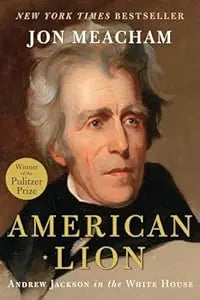
American Lion (Andrew Jackson) HC
American Lion (Andrew Jackson) HC
Couldn't load pickup availability
American Lion: Andrew Jackson in the White House is a 2008 biography of Andrew Jackson, the seventh President of the United States, written by Jon Meacham. It won the 2009 Pulitzer Prize for Biography, with the prize jury describing it as "an unflinching portrait of a not always admirable democrat but a pivotal president, written with an agile prose that brings the Jackson saga to life".[1]
Meacham wrote American Lion drawing in part on previously unavailable documents, including letters, diaries, memorabilia, and accounts from Jackson's intimate circle that had been largely privately owned for 175 years. Much of the correspondence was found in archives at the Hermitage, Jackson's estate in Nashville, Tennessee. American Lion is not a full-scale account of Jackson's entire life or political career, but rather focuses on his presidency and his domestic arrangements in the White House.
American Lion focuses a great deal on the Bank War, the federal tariff on imports, and the Petticoat affair, during which Meacham claimed "the future of the American presidency was at stake".[2] Meacham believed Jackson represented the best and worst of American character, citing his simultaneous capacity for kindness and cruelty. Of all the early U.S. presidents and Founding Fathers, Meacham believed Jackson was "the most like us",[3] and had the strongest influence on the modern presidency. In writing American Lion, Meacham said he sought not to whitewash Jackson or "all his sins, which are enormous",[4] such as his support of slavery and Indian removal.
Synopsis

American Lion opens just after Andrew Jackson's victory in the 1828 United States presidential election. Author Jon Meacham writes about the viciousness of the election and the death of Rachel Jackson immediately afterward, which Jackson blames on his attacks by his political enemies during the campaign. The book then touches upon Jackson's early life, including his birth in the Waxhaws region of the Carolinas and his family life. It briefly covers his marriage to Rachel, legal career, move to Nashville, Tennessee, and his military career, particularly his role in the Battle of New Orleans and the part it played in elevating his reputation.[5] The book then segues into the beginning of his political career, his rivalries with Henry Clay and John C. Calhoun, and his loss in the 1824 presidential election despite winning the popular vote, which Jackson regarded as a "corrupt bargain" by his political enemies.[6]
Returning to Jackson's presidency, Meacham defines patronage, the Bank War, the nullification crisis, Indian removal, clerical influence in politics, internal improvements, and respect abroad as the questions that would define Jackson's White House years.[7] Meacham wrote that, to many in established Washington, Jackson's arrival "signaled the destruction of the rule of the nation in an atmosphere of geniality and gentility".[8] By contrast, Meacham wrote that Jackson felt the country was "suffering from a crisis of corruption (in) the marshaling of power and influence by a few institutions and interests that sought to profit at the expense of the whole".[8] According to the book, Jackson felt the President should "use his powers with a firm hand", whereas his foes thought of Congress as the government's center of gravity.[9] Meacham wrote that Jackson's most enduring conviction was that, as President, he was acting selflessly in the interest of the nation and of its mass of citizens, and that his own will was the same as the will of the country.[10] Meacham wrote: "No institution, he argued, should stand between the people and the presidency. ... No president had spoken in such a way before."[11]

Meacham focuses a great deal on Jackson's determination to end the Second Bank of the United States, which was presided over by Nicholas Biddle, and which Jackson believed had been manipulated by Clay to assist with John Quincy Adams's election to the presidency in 1824.[12] Jackson regarded the bank as a fundamentally corrupt institution and "the embodiment of unfair privilege".[13] The book highlights Biddle's challenge to Jackson in pressing for recharter and his attempt to use the influence of the Bank to harm his reelection.[14] It covers Jackson's veto of the charter,[15] attempts by Biddle and Clay to see the veto overridden,[16] and ultimately the decision by the United States House of Representatives in 1834 not to override the veto, ensuring the Bank would not be rechartered.[17]
The book also discusses Jackson's role in the removal of Native Americans to lands west of the Mississippi River. Meacham wrote: "Jackson believed in removal with all his heart, and by refusing to entertain any other scenario, he was as ferocious in inflicting harm on a people as he often was in defending the rights of those he thought of as the people."[18] As the book recounts, Jackson was not compelled by treaties signed and assurances previously provided to Native Americans; he did not believe that they had title to the land, and he would not tolerate what he felt were competing sovereignties within the nation.[19] It details Jackson's support for the successful passage of the Indian Removal Act, which would ultimately lead to the Trail of Tears.[20]
American Lion also highlights Jackson's feelings on what he called the "absurd and wicked doctrines of nullification and secession",[21] and his confrontation with the state of South Carolina regarding the issue of nullification after the state declared the Tariffs of 1828 and 1832 unconstitutional and therefore void within the state's boundaries.[22] Meacham described the nullification crisis as "perhaps the most delicate mission of his life – how to preserve the Union without appearing so tyrannical and power-hungry that other Southern states might join with South Carolina, precipitating an even graver crisis that could lead to the secession of several states."[23] The book covers Jackson's support of the Force Bill, which authorized the President to use military forces against South Carolina if necessary,[24] as well as the Compromise Tariff of 1833, which ultimately ended the crisis.[25]
Finally, the book focuses on Emily Donelson's role as White House hostess and de facto First Lady of the United States. Meacham wrote: "Family life was crucial to Jackson, who had known so little of it growing up, and Emily ensured that the White House was a sanctuary for him."[26] The book also discusses the Petticoat affair, during which Jackson's Secretary of War John Eaton was socially ostracized due to his wife Peggy Eaton's perceived moral failings and lack of sexual virtue. The scandal generated considerable chaos and controversy during Jackson's administration,[27] during which Jackson felt, according to Meacham, that "to acknowledge the Eatons was to side with Jackson; to snub the Eatons was to oppose Jackson".[28] Meacham wrote that Jackson's interpretation of the Petticoat affair was that he was "acting for the common democratic good", while aristocratic elites were acting against him out of jealousy of his power in Washington.[29] The book highlights how Martin Van Buren endeared himself to Jackson by siding with him during the scandal,[30] and how the Petticoat affair led to resignations from Jackson's cabinet that sparked "a national debate over Jackson's first three years of leadership and whether he should have another term".[31]
Following the conclusion of Jackson's two terms, American Lion ends with a brief synopsis of his post-presidential life,[32] including Emily Donelson's death,[33] and Jackson's own death in 1845.[32]